
Grinnell, Iowa / Case study
Our point repair addressed groundwater entering Grinnell's sewer.
CIT Sewer Solutions inspected the City's sanitary sewer serving the Melrose Lift Station, located an infiltration defect, and repaired it from inside the existing pipe on August 27, 2026.
Lower average daily effluent
The City's recorded flow was lower after the repair.
7,954 gallons per day before repair. 2,889 gallons per day afterward.
Observed comparison: August 21 to 26, 2026 (6 days) and August 28 to 30, 2026 (3 days). Weather, groundwater, and system usage can also affect flow.
Review the flow comparison.- Asset owner
- City of Grinnell
- Project asset
- Sanitary sewer serving the Melrose Lift Station
- Repair date
The problem
We found a groundwater entry path in the City's sewer.
Grinnell was experiencing elevated flow entering the Melrose Lift Station. As part of the City's evaluation and inflow and infiltration work, our crew inspected the sanitary sewer leading toward the station with closed-circuit television (CCTV).
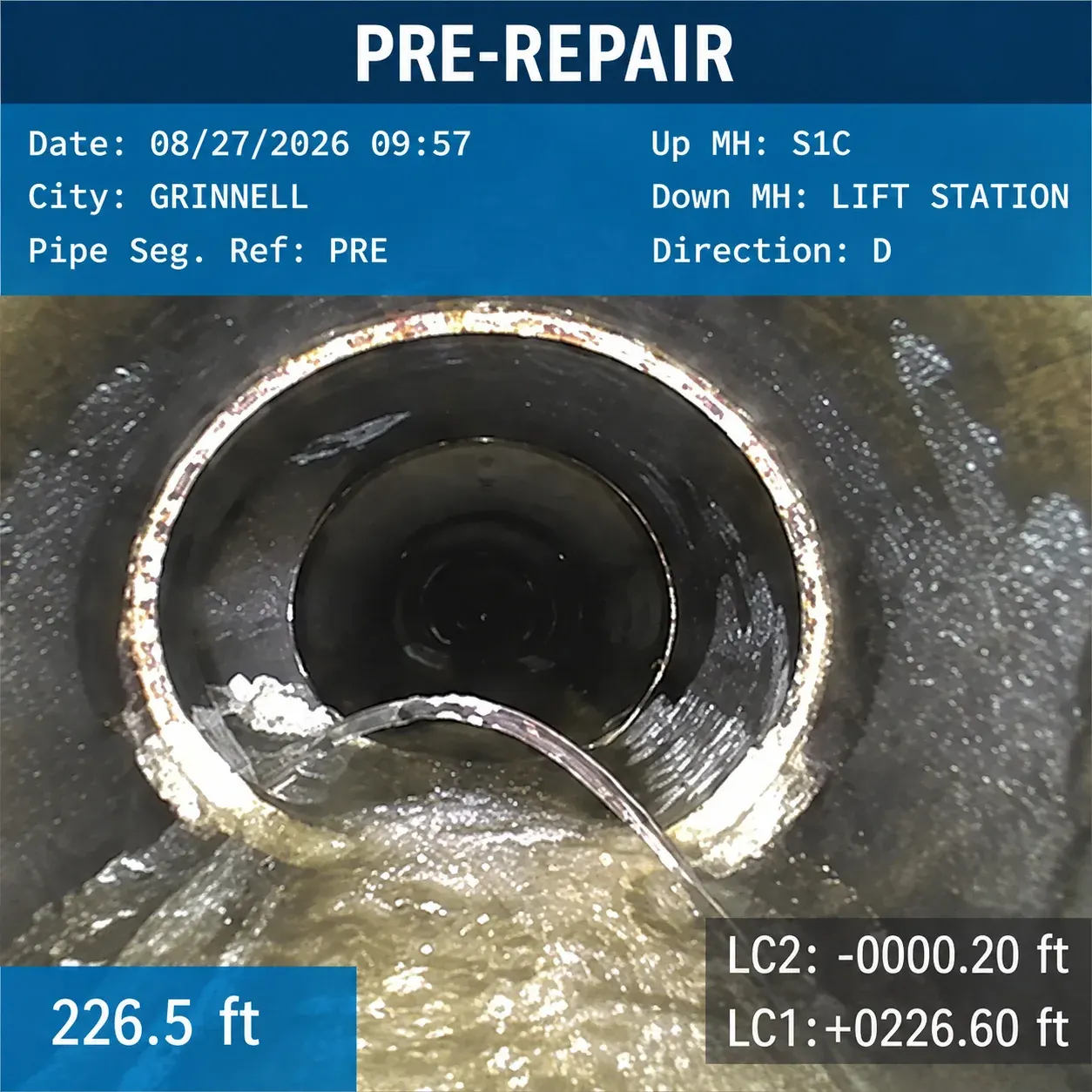
The inspection identified a significant defect approximately 226 feet into the run. Groundwater could enter the City's sanitary sewer through this damaged location, adding water for the lift station to handle.
Our field work
We repaired the defect from inside the existing pipe.
Our crew performed a targeted trenchless point repair at the identified defect on August 27, 2026. Working at that location inside the City's sewer allowed us to repair the damage without excavating and replacing a long section of pipe.
We inspected the completed repair with CCTV. The before-and-after views document the damaged location and the installed repair within Grinnell's sewer.
Inspection evidence
Our cameras recorded the defect and the completed repair.
Before repair
After repair
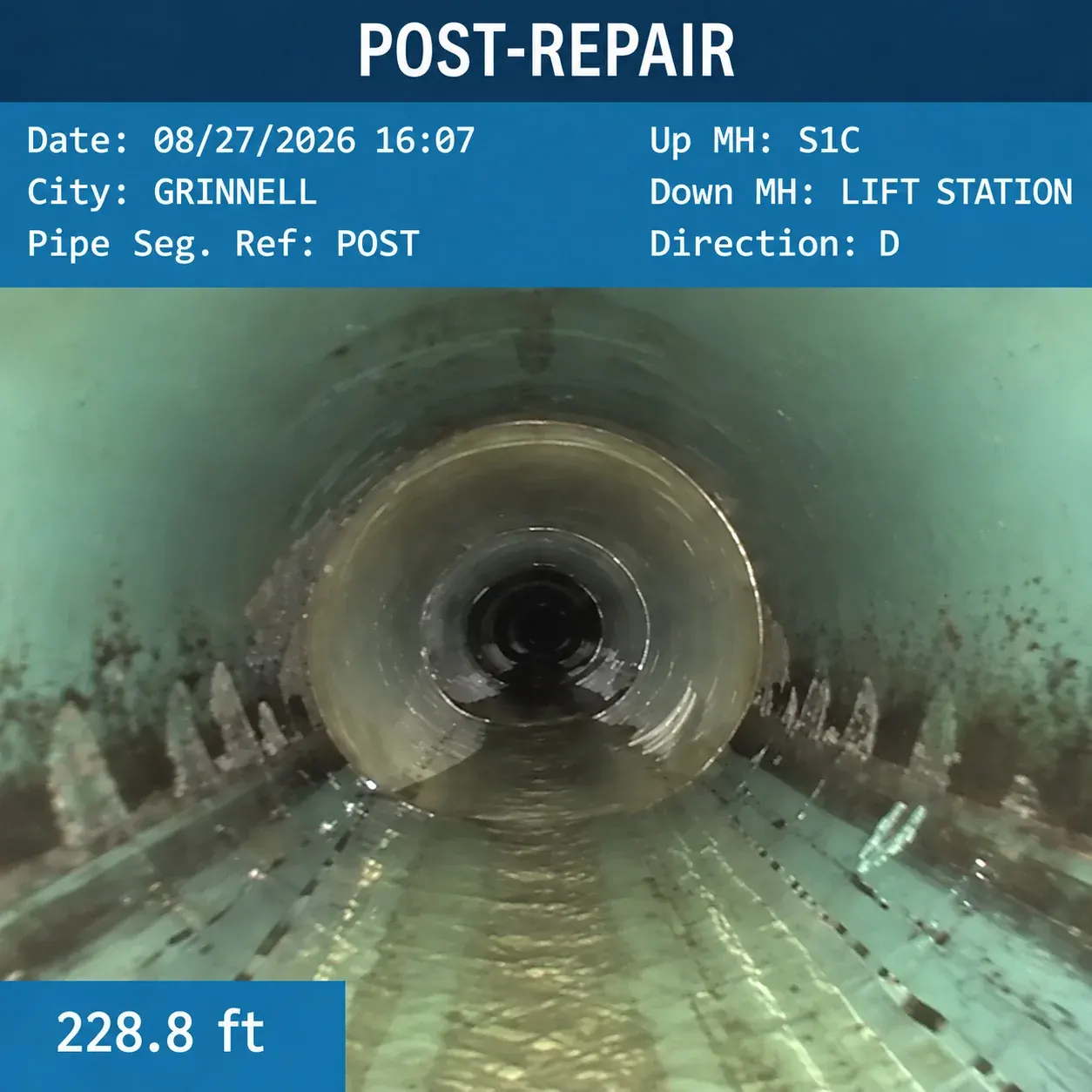
The two inspections show the repair area from different camera positions.
Observed results
Grinnell recorded lower average daily effluent after the repair.
The City's reported lift-station readings averaged 7,954 gallons per day over the six days before the repair and 2,889 gallons per day over the three days afterward. That is an observed decrease of 5,065 gallons per day, or 63.7 percent.
The comparison uses average daily effluent because the two periods contain different numbers of days. The August 27 repair day is excluded because its daily total was not supplied.
August 21 to 26, 2026 / 6 days
August 28 to 30, 2026 / 3 days
These readings compare six days before the repair with three days after it. Weather, groundwater conditions, and system usage can also affect flow. This short observation period does not establish a sustained reduction or isolate the repair as the only cause.
Review the daily flow readings and calculation.
| Date | Period | Gallons |
|---|---|---|
| Before repair | 8,889 | |
| Before repair | 8,621 | |
| Before repair | 8,128 | |
| Before repair | 7,398 | |
| Before repair | 7,322 | |
| Before repair | 7,364 | |
| After repair | 2,045 | |
| After repair | 3,179 | |
| After repair | 3,442 |
The 6 readings before repair total 47,722 gallons; the 3 readings after repair total 8,666 gallons. Dividing each total by its number of days gives the average daily effluent. The percentage decrease is the difference between the unrounded averages divided by the average before repair. Displayed averages are rounded to whole gallons.
Your sewer system
We can investigate unwanted flow and repair the defects in your sewer.
A localized defect can admit groundwater even when your surrounding sewer does not need full-length rehabilitation. Our CCTV crew can locate visible damage and water entry, and our repair crew can treat suitable isolated defects with point repairs.
If unwanted flow has several possible sources, our I&I investigation services can help identify where further inspection or corrective work is needed. We match the work to the conditions in your system.
Discuss a sewer point repair.
Tell us your project location, the sewer assets needing work, and the problem your team has found. Mention any available CCTV so we can arrange to review it. You can contact us before choosing a repair method.